How to Make a Dog Emergency Medication List Before You Need It
Dog emergency medication list basics: organize doses, refill details, and vet contacts now so a stressful moment has one less unknown.
The first time you need information about your dog’s medication is a terrible time to go looking for it. You are already grabbing keys, trying to remember when the last dose happened, and wondering whether the bottle is still in the kitchen drawer or somehow migrated to the bathroom. A dog emergency medication list will not make an emergency feel easy, but it can remove one very avoidable layer of chaos.
This is not about becoming paranoid or building a pharmacy at home. It is about leaving clear information for future-you, a family member, a pet sitter, or the veterinary team who may need the facts quickly. If your dog takes anything regularly, even a simple one-page record can be a genuinely useful part of your emergency plan.
Start with the facts, not your memory
For every medication your dog currently takes, write down the exact name shown on the package, the strength, the amount you give, and the schedule your vet prescribed. “The little white pill” is a perfectly understandable description at home, but it is not very helpful when someone else is trying to understand what happened.
Add the reason it was prescribed if you know it, plus the date and time of the most recent dose. The last part is easy to skip until it suddenly matters. If your dog is seen by an emergency vet, knowing whether a medication was given at 7 a.m. or 7 p.m. can help them make safer decisions.
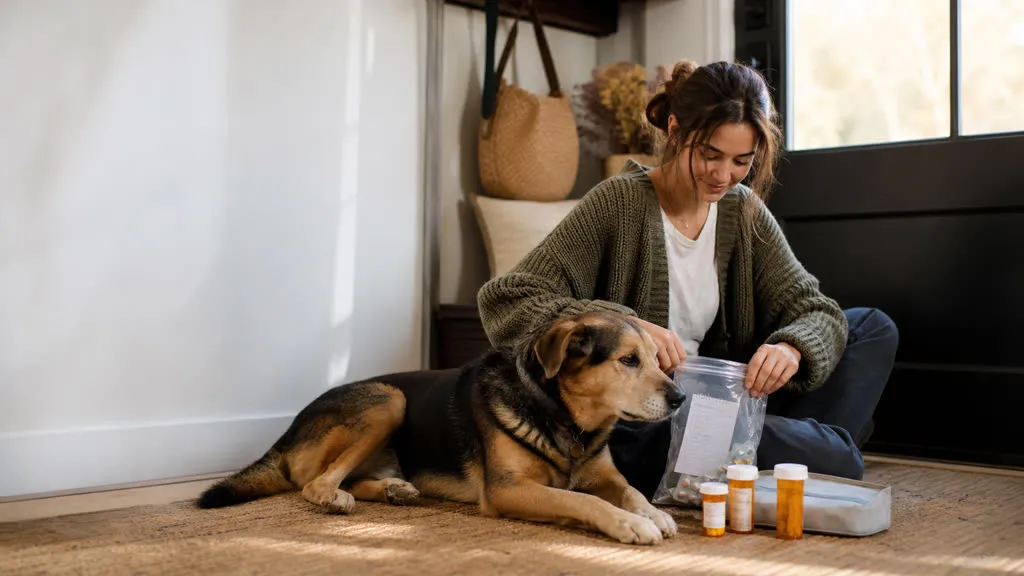
Keep the original bottles with their labels whenever possible. A photo of each label stored with your dog emergency medication list is a solid backup, especially if the printed label gets smudged or a bottle is left at home during a rushed trip.
Include the people who can answer the hard questions
Your medication list should also have your regular veterinarian’s name and phone number, the number for a nearby after-hours hospital, and the pharmacy that fills your prescriptions. If your dog sees a specialist, add that contact too.
It is tempting to make the list only about medicine, but a short note about known allergies, ongoing conditions, and any recent changes can save a lot of repeated explaining. Keep it factual. You do not need to write a medical biography, just enough context to point the right person in the right direction.
The American Veterinary Medical Association recommends including medication names, doses, and frequencies in a pet evacuation kit, along with copies of medical records and veterinarian contact information. That is a good baseline because emergencies are not always medical. A power outage, evacuation, or unexpected overnight stay can make ordinary routines complicated fast.
Keep enough supply, then rotate it
A list is only useful if the medication is actually available. Check refill dates before a holiday weekend or travel day, not when the last tablet is already gone. The AVMA suggests keeping a two-week supply of prescribed medication in an emergency kit when practical, then rotating it so nothing quietly expires.
That does not mean doubling a dose, sharing medication, or adding over-the-counter products on your own. Every dog and every prescription is different. If you are unsure what belongs in an emergency kit, ask your vet to help you make a plan for your specific dog.
A small waterproof pouch can hold copies of the list, medication labels, and any printed instructions your vet has given you. Keep it somewhere obvious and tell the people in your home where it lives. The best organization system is the one another person can use without needing a tour.
Make the list easy to update
This part is where good intentions usually lose. A medication changes, a refill comes in with a new label, and the carefully made document becomes old news.
Give yourself one tiny routine: update the record when you add a prescription, change a dose, or request a refill. Arya was built because managing pills, drops, schedules, and refills can become overwhelming faster than anyone expects. Using an app to log doses and keep medication details in one place means your dog emergency medication list is not another paper you have to remember to rewrite.
You can still keep a printed copy in the emergency pouch. Digital and paper backups work well together. One is easy to update, and the other is there when your phone is dead, lost, or sitting on the charger at home.
When something feels urgent, call instead of guessing
A list helps you communicate, but it does not replace veterinary advice. If your dog has trouble breathing, collapses, has a seizure, may have eaten something toxic, or seems seriously unwell, contact an emergency veterinary clinic right away. Bring the medication containers and your notes with you if you can, but do not delay care to make the list perfect.
The goal is not to predict every bad day. It is to prepare for the boring details while things are calm, so you have more attention left for your dog when it counts.
If medication routines are already taking up too much brain space, try Arya: Pill Reminder on the App Store or Google Play. One less “did I remember that?” is worth having. 🐾