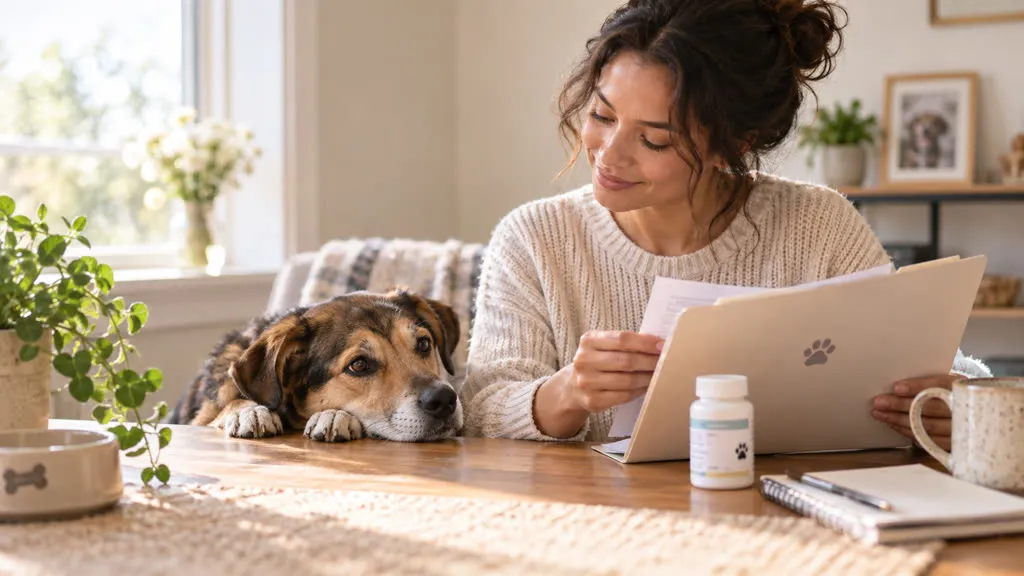
How to Organize Your Dog's Medical Records Before You Need Them
How to organize your dog's medical records, medication list, and vet contacts so the next appointment or emergency feels less chaotic.
The worst time to hunt for your dog’s medical records is when someone is waiting for an answer. A new vet asks which antibiotic caused that reaction. You are packing for a trip. It is late, your dog is acting off, and you cannot remember the name of the eye drops from six months ago.
I learned this the hard way with Arya. Her health problems started when she was young, and her care eventually involved appointments, tests, antibiotics, pills, and eye drops. The hard part was not only following each instruction. It was keeping the whole story straight when the story kept changing.
Knowing how to organize your dog’s medical records will not replace a veterinarian. It can make the next conversation with one much clearer. It also means less time digging through old chats, paper folders, and blurry photos while your brain is already in panic mode.
Start with the information a vet actually needs
A useful record is not a giant archive dumped into one folder. It should let you answer a few basic questions quickly: Who is your dog? Which clinic usually sees them? What are they taking right now? What has happened before?
Keep your dog’s name, age, microchip number if they have one, usual veterinarian, emergency clinic, and insurance details together. Add the clinic phone numbers and address. If your dog stays with family, a sitter, or a boarding place, this page is the one they should be able to find first.
Next comes the current medication list. Write the medication name exactly as it appears on the label, the strength, how much your dog takes, how often, why the vet prescribed it, and the date it began. Include supplements and preventives too. A medication list that says only “one pill at night” is not enough when another person needs to help.
The American Veterinary Medical Association recommends bringing a medication list with the dose and frequency to appointments. VCA also advises sharing records before a visit, including treatments, medications, and past reactions. Those details help a new clinic see the bigger picture without making you reconstruct it from memory.
Keep a short timeline, not a novel
You do not need to write every sleepy afternoon or every normal meal. Track the moments that change the care plan. A date, a short note, and a photo or document link often do the job.
For a vet visit, save the reason for the visit, the diagnosis or working concern if your vet gave one, treatments started or stopped, lab results, and the next step. If your dog had a reaction to a medication, write what you observed, when it started, and what the clinic told you to do. Do not label it an allergy yourself if a vet has not confirmed that. Just preserve the facts.
This is especially helpful when different people care for the same dog. A clean timeline means you do not have to rely on someone saying, “I think it was around spring?” That sentence has ruined more than one calm evening.
Make paper and digital records work together
Paper records are still useful. Keep vaccination certificates, lab printouts, prescriptions, and discharge instructions in one labeled folder. Put the latest medication list at the front. If you ever need to leave quickly, you can grab it without sorting through a drawer.
Then make a digital backup. Scan or photograph important documents in good light and give files names you can search later, such as 2026-09-26 bloodwork or 2026-09-26 discharge instructions. Store them in one cloud folder that you can access from your phone. Keep a copy available offline before a long trip or during storm season.
The AKC and AVMA both include medical records and medications in pet emergency planning. That is a practical reason to keep this information current, not an excuse to spend a whole Sunday building a color-coded spreadsheet you will never open again.
Use a simple routine to keep it current
The system only works if it survives a normal busy week. After each vet visit, spend five minutes adding the new document and updating anything that changed. When a prescription changes, update the current medication list that same day. When you refill something, check whether your supply is still easy to see.
If you manage doses with someone else, agree on one source of truth. Arya: Pill Reminder can help you keep medication schedules and dose notes in one place, so you are not trying to decode a text thread at 10 p.m. It is not a medical record system or a substitute for your vet. It is a way to make the daily part less fragile.
Bring the right record to the next appointment
Before a routine visit, send or bring recent records, the current medication list, and any short timeline notes that relate to the visit. If you are seeing a new veterinarian, include prior test results and previous treatment instructions when you have them. Your vet can decide what is relevant, but having the documents ready saves time.
For an emergency, focus on the present first. Bring the medication list, recent records if you can grab them, and the medication containers. Then let the clinic guide you. Do not delay urgent care because you are trying to build the perfect folder.
A record system is boring right up until it saves you from guessing. That is enough reason to build one. If daily medication tracking is part of your dog’s care, download Arya: Pill Reminder on the App Store or Google Play and give future-you one less thing to remember.