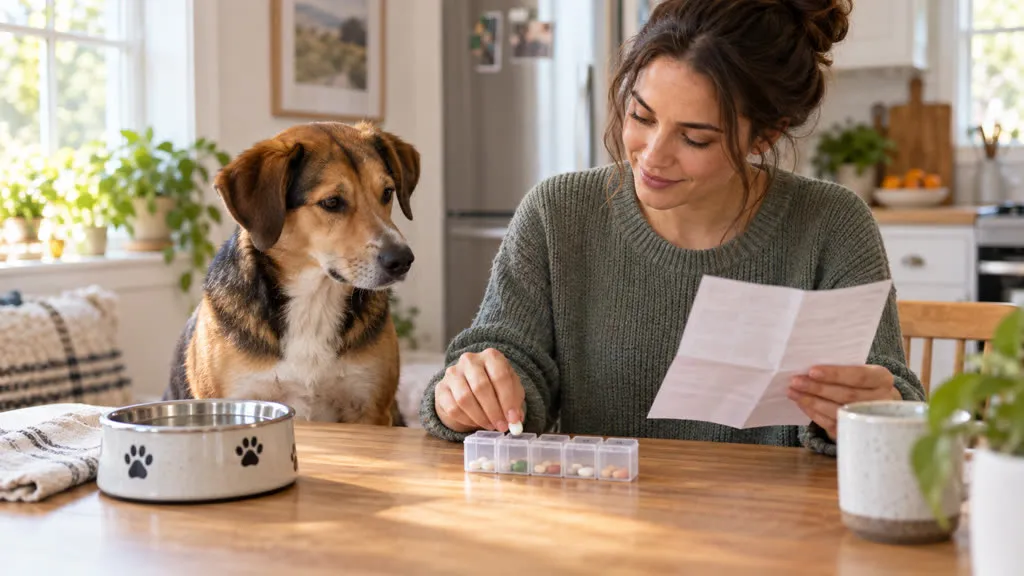
Dog medication change checklist: how to reset the routine safely
Dog medication change checklist for pet parents who need to update a routine after a vet adjusts a prescription.
A medication change can make an ordinary Tuesday feel way more complicated than it should. You leave the vet with a new dose, a different schedule, maybe a new bottle, and then get home to the routine that was finally working.
That is when a dog medication change checklist helps. Not because pet parents need another chore, but because the dangerous part is often the in-between moment: the old instructions are still in your head while the new ones are on a piece of paper somewhere in the kitchen.
I learned this the hard way while caring for Arya. Her health problems began when she was young, and managing antibiotics, pills, drops, and changing instructions could get overwhelming fast. The goal is not to become your dog’s pharmacist. It is to make the vet’s plan easy to follow when life gets noisy.
Start with the instructions from this visit
Before moving anything in your routine, put the new directions in one place. Confirm the medication name, strength, amount, frequency, route, start date, and whether the old medicine should stop right away or overlap for a set time. If a label and the verbal instructions do not match, call the clinic before giving the next dose.
It also helps to ask one plain question before you leave: “What should I do if I miss a dose?” The answer depends on the specific medicine and the timing. Do not make up a catch-up plan or double a dose unless your vet has told you to.
Clear the old routine before the new one begins
A good dog medication change checklist includes the places where the old schedule is hiding. Check the fridge, the counter, your reminder app, calendar alerts, pill organizer, notes for a family member, and any instructions left with a sitter.
Update them all in the same sitting. Half-updating a routine is how a 7 p.m. alarm keeps going off for a medicine that was changed to mornings. If the vet stopped a medicine, separate it from active medications right away. Keep it in its original container and ask the clinic or local pharmacy how to dispose of it safely when you are ready. Do not leave it mixed into a daily organizer just because you might need it later.
Make the first few doses boring on purpose
The first doses after a change are worth giving when you can pay attention. Pick a calm time, have the prescribed amount ready, and use the exact method your vet recommended. If you are giving an oral medication, Cornell’s veterinary guidance recommends preparing it first and giving liquid slowly into the side of the mouth so the dog can swallow between small amounts.
Watch your dog long enough to confirm the medication was actually taken. Some dogs are absolute pros at hiding a tablet in their cheek and dropping it behind the couch two minutes later.
If food is part of the instruction, follow that instruction. If you are tempted to crush a pill, mix it into a favorite food, or switch the time to fit your day, check first. Those changes are not harmless for every medication.
Keep a simple record, especially during the transition
You do not need a color-coded spreadsheet. Record the date and time, what was given, and anything your vet asked you to watch. A short note such as “first dose, ate dinner normally” is enough. The point is to have a clean answer if the clinic asks what happened and when.
This is where Arya: Pill Reminder came from for me. I built it because I was tired of second-guessing whether a pill or drop had already been given. A reminder and a confirmed dose log do not replace veterinary advice, but they remove one easy-to-avoid source of stress.
Know when to pause and call
A routine can wait when something does not look right. Call your veterinarian or an emergency clinic if your dog has a concerning reaction, cannot keep the medication down, seems to be struggling to breathe, collapses, or you think they received the wrong medicine or amount. Keep the package nearby when you call.
For less urgent uncertainty, call before the next dose rather than improvising. No one gets a prize for guessing correctly. Clinics answer these questions every day.
A dog medication change checklist is really a way to protect the boring parts of care: clear instructions, one current schedule, and a record you can trust. Once those are in place, you can get back to being with your dog instead of replaying the label in your head.
If medication schedules are taking up too much mental space, download Arya: Pill Reminder on the App Store or get it on Google Play. It is built for the moment when you need to know, not guess, whether the dose is done.