How to Build a Dog Medication Routine That Actually Sticks
Struggling to keep up with your dog's daily meds? Here's a practical guide to building a dog medication routine that works, and how to stop missing doses.
The first time Arya came home with a prescription bottle, I thought: “Two pills, twice a day. Easy.”
Six weeks later I’d missed at least four doses, given her a morning pill at 11 PM because I forgot in the morning, and Googled “is it okay if my dog skips one pill” more times than I’d like to admit.
It wasn’t laziness. It was just life. And if your dog is on any kind of ongoing medication, allergy pills, thyroid meds, antibiotics, or seizure control. You already know what I mean.
So here’s what I actually learned about building a dog medication routine that holds up when real life is happening around you.
The problem isn’t motivation, it’s system design
Most advice starts with “just set a reminder.” And sure, alarms help. But an alarm that fires while you’re in the middle of a meeting, or at the gym, is easy to dismiss. You think “I’ll do it when I get home,” and then you forget. Again.
A good routine doesn’t rely on willpower or perfect timing. It links the medication to something that already happens every single day without fail.
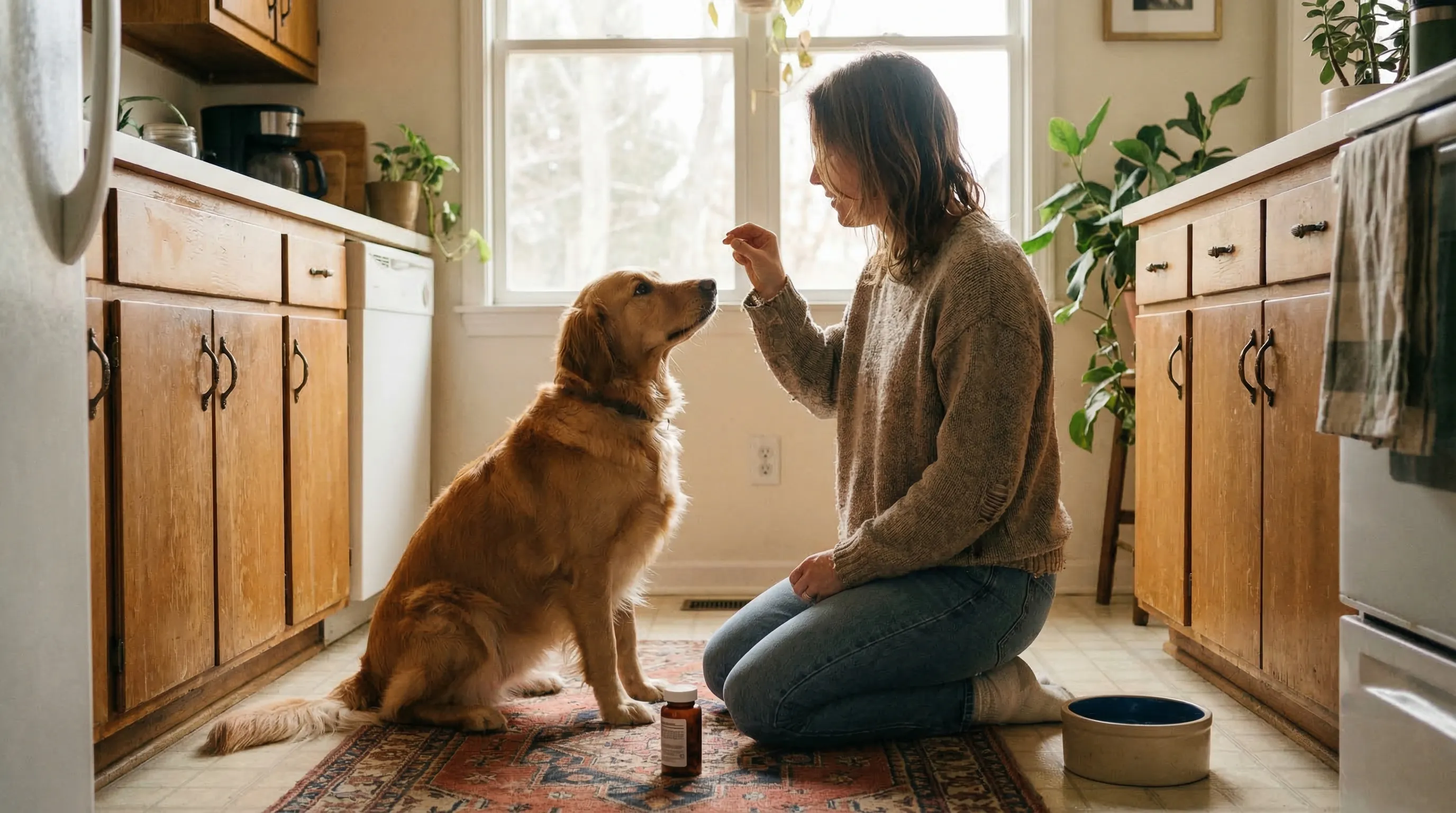
For Arya, that anchor was breakfast. The moment I set her food bowl down became the trigger. No bowl touches the floor until the pill is already in it. She doesn’t know anything changed. I haven’t missed a morning dose since I made that rule.
Evening was trickier. There’s no equivalent ritual. That’s where an app came in.
How to anchor meds to existing habits
Think about your dog’s day and find the moments that never move:
Morning feeding. Evening walk. Your own bedtime routine. The moment you put your keys on the counter.
Pick one anchor per dose. Not “sometime in the morning,” just a specific physical moment you already do every day. The more concrete, the better.
If your dog gets two doses, find two anchors. If the doses need to be spaced a certain number of hours apart, that’s where a reminder app earns its keep, not to replace the habit, but to back it up when the anchors are too far apart to be natural.
The forgotten-dose problem
Here’s the thing nobody talks about: it’s not missing the dose that’s the real issue. It’s not knowing whether you already gave it.
You walk into the kitchen at 7pm and see the pill sitting on the counter. Did you forget to give it this morning? Or did you give it and forget to put the bottle away? Your dog cannot tell you. And guessing wrong in either direction can be a problem depending on the medication.
The fix is a log. Not a spreadsheet, just a simple “given / not given” that resets every day. You tap it when you give the pill. Later, if you’re unsure, you check. That’s it.
This sounds almost too simple, but it eliminates a daily source of anxiety completely. With Arya’s meds, I built a small tracker into the app I made for her: Arya: Pill Reminder, exactly because I was tired of second-guessing myself every evening.
What to do when your routine breaks
Travel. Houseguests. A rough week at work. Life disrupts routines. When it does, don’t try to rebuild the whole system from scratch.
Have one backup: a designated person who knows the routine. Tell your partner, a family member, or a dog sitter the exact anchor, the exact dose, and where the medication lives. Write it down somewhere visible: on the fridge, in a note, wherever. If you’re traveling, hand off the log so they can track it too.
The goal isn’t a perfect unbroken streak. It’s making sure your dog gets the treatment they need even when you’re not at 100%.
Seasonal and long-term medications need a different system
There’s a difference between a two-week course of antibiotics and a medication your dog will take for the rest of their life. Short courses are easier to track. They have a clear end. Long-term meds are where routines really matter, because the stakes are higher and the fatigue of routine is real.
For long-term medications, a couple of extra things help:
Keep the medication in the most visible spot possible. Not in a cabinet. On the counter. Where you already look every morning.
Review the routine every few months. Sometimes life shifts, a new job, a new feeding time, a new home, and the anchor that used to work stops working. That’s not a failure, it’s just maintenance. Update the anchor and move on.
Set a refill reminder before you run out, not when you realize you’re on the last pill. Running out unexpectedly is one of the most common ways dogs miss doses, and it’s completely avoidable.
A system built out of necessity
I’m not a veterinarian or a pet care expert. I’m just someone whose dog got sick and who had to figure this stuff out the hard way.
Arya has been on medication on and off since she was a puppy. The routine I described above (the anchor, the log, the backup plan) came from failing enough times to understand what actually works.
If your dog is starting a new prescription, or you’re struggling to stay consistent with one they’ve been on for a while, give those three things a try. They cost nothing to set up and they’ll save you a lot of anxiety.
And if you want a simple app to handle the reminders and the log in one place, the one I built for Arya is available on both iOS and Android. No subscriptions, no bloat, just the basics that actually help.
Your dog is counting on you. You’ve got this. 🐾