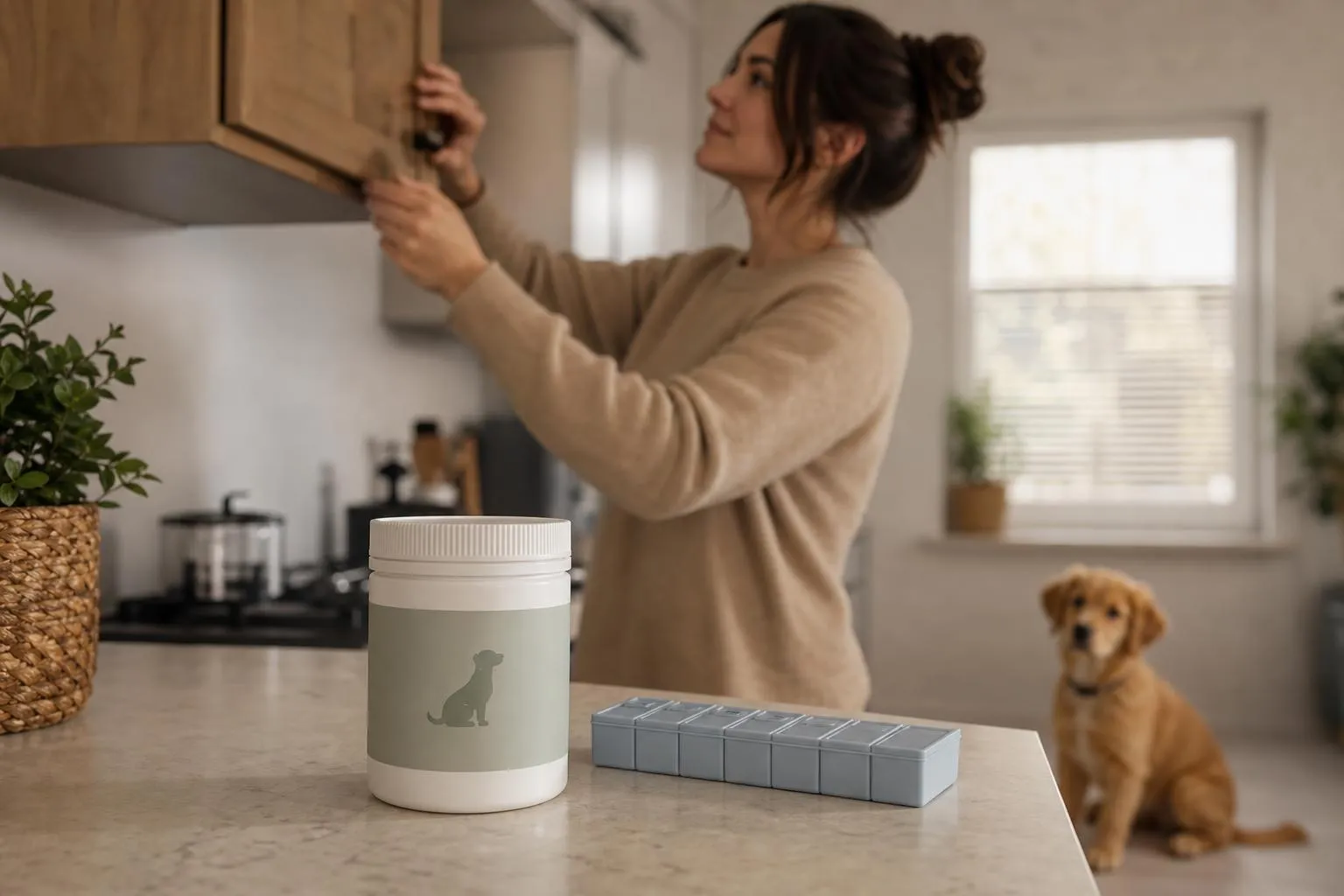
How to Store Your Dog's Medication Safely at Home
Dog medication storage matters more than it seems. Learn how to keep pills, drops, refills, and instructions safer at home.
There is a funny little trap with dog medication storage: once the treatment becomes part of your routine, the bottle starts feeling harmless.
It sits on the kitchen counter. Or beside the coffee maker. Or on the nightstand because that is where you remember the morning dose.
And then one day your dog gets curious, a pill organizer is left open, or someone in the house moves the bottle and suddenly the whole system is not really a system anymore.
When Arya was going through antibiotics, eye drops, follow-ups, and all the tiny instructions that came with her treatment, I learned that giving the medication was only one part of the job. The other part was keeping everything organized enough that I did not create a new problem while trying to solve the original one.
Dog medication storage is not glamorous. It is not the part anyone posts about. But it matters, especially when you have more than one medication, more than one person helping, or a dog who thinks every small plastic container deserves a full investigation.
Keep pet meds away from human meds
This sounds obvious until real life happens.
Human medications, pet medications, vitamins, supplements, eye drops, creams, and refills can all end up in the same cabinet if you are tired enough. That is where mistakes become easier.
A safer setup is to give your dog medications their own clearly labeled spot. Not just “somewhere in the medicine cabinet”, but a specific container, shelf, or drawer that everyone in the house understands.
Veterinary hospitals often recommend storing human and pet medications separately and keeping labels readable, because the drug name, dose, pharmacy information, and prescription details are what you need when giving meds, requesting refills, or calling the clinic.
The goal is boring clarity.
When you are half-awake, busy, or stressed, you should not have to decode which bottle belongs to whom.
Out of reach does not mean almost out of reach
Dogs are weirdly talented when motivation is involved.
A pill bottle on a counter may feel safe because your dog has never grabbed one before. A weekly pill organizer may feel safe because it clicks shut. A nightstand may feel safe because the dog “usually” ignores it.
“Usually” is doing a lot of dangerous work there.
Many pet poisoning cases start with medication left on nightstands, counters, tables, bags, or low shelves. Some containers are child-resistant, but that does not make them pet-proof. A determined dog does not need to read the label. They just need enough time to chew.
So the better rule is simple: medication should live behind a closed cabinet, inside a secure box, or somewhere your dog cannot reach even on a creative day.
If your dog is young, bored, anxious, tall, or suspiciously smart, assume the easy places are not safe places.
Do not leave loose pills around
Loose pills are chaos in tiny form.
They fall under tables. They roll under appliances. They blend into floors. They get mistaken for crumbs by the only family member who should absolutely not eat them.
If you use a pill organizer, fill it away from your dog and close it immediately. If a pill drops, pause and find it before moving on. If a dose needs to be split, keep the pieces in a labeled container instead of leaving them in a random dish or napkin.
That last one is painfully easy to do when you are rushing.
Also, keep the original bottle or label available whenever possible. If something goes wrong, your vet or poison control service will need the medication name, strength, and how much may have been ingested. Guessing under stress is not a fun hobby.
Store based on the label, not vibes
Some medications are fine at room temperature. Some need refrigeration. Some should stay away from light, heat, moisture, or freezing temperatures. Some liquids need shaking. Some compounded medications have shorter expiration windows.
The label wins.
Do not move a medication into a cute container if that means losing the storage instructions. Do not keep meds in a sunny kitchen spot because it is convenient. Do not store everything in the bathroom if humidity is a problem.
Convenience matters, but only after safety.
The best place is the one that matches the medication instructions, stays out of your dog’s reach, and is easy enough that you will actually use it every day.
Make a tiny home medication station
You do not need a pharmacy-grade setup.
You need one place where the routine makes sense.
For me, the ideal setup is a secure container or cabinet area with the current medications, the readable labels, the dosing notes, a small weekly organizer if your vet is okay with that workflow, and a clear way to track what has already been given.
That last part matters because storage and scheduling are connected. A perfectly stored medication can still become a problem if nobody knows whether the 8 AM dose happened.
This is where Arya helped me personally. I built it because I was tired of second-guessing myself during Arya’s treatment. The app keeps the medication schedule, dose reminders, and refill notes in one place, so the physical storage at home does not have to carry the entire mental load.
If your dog gets into medication
Do not wait to see what happens.
Call your veterinarian, an emergency veterinary clinic, or a pet poison control service as soon as possible. Have the medication container ready. Tell them the name, strength, how much might be missing, your dog’s weight, and when it happened.
Do not try to induce vomiting unless a veterinary professional tells you to. Do not give another medication to “counteract” it. Do not rely on internet comments when the clock matters.
Your job in that moment is to get accurate information to the right professional quickly.
The simple rule that prevents most messes
Dog medication storage should make the correct action the easiest action.
The right bottle is easy to identify. The pills are not reachable. The label is readable. The refill timing is tracked. The dose schedule is clear. Everyone in the house knows where things go.
None of that needs to be fancy.
It just needs to survive a normal day: someone rushing, someone tired, a dog being curious, and a medication routine that has become familiar enough to stop feeling risky.
If you are managing your dog’s meds at home, you can download Arya on the App Store or Google Play. It will not organize your cabinet for you, sadly, but it can help you keep the schedule and refill side of the routine from living entirely in your head.
And honestly, with pet meds, getting things out of your head is half the battle.