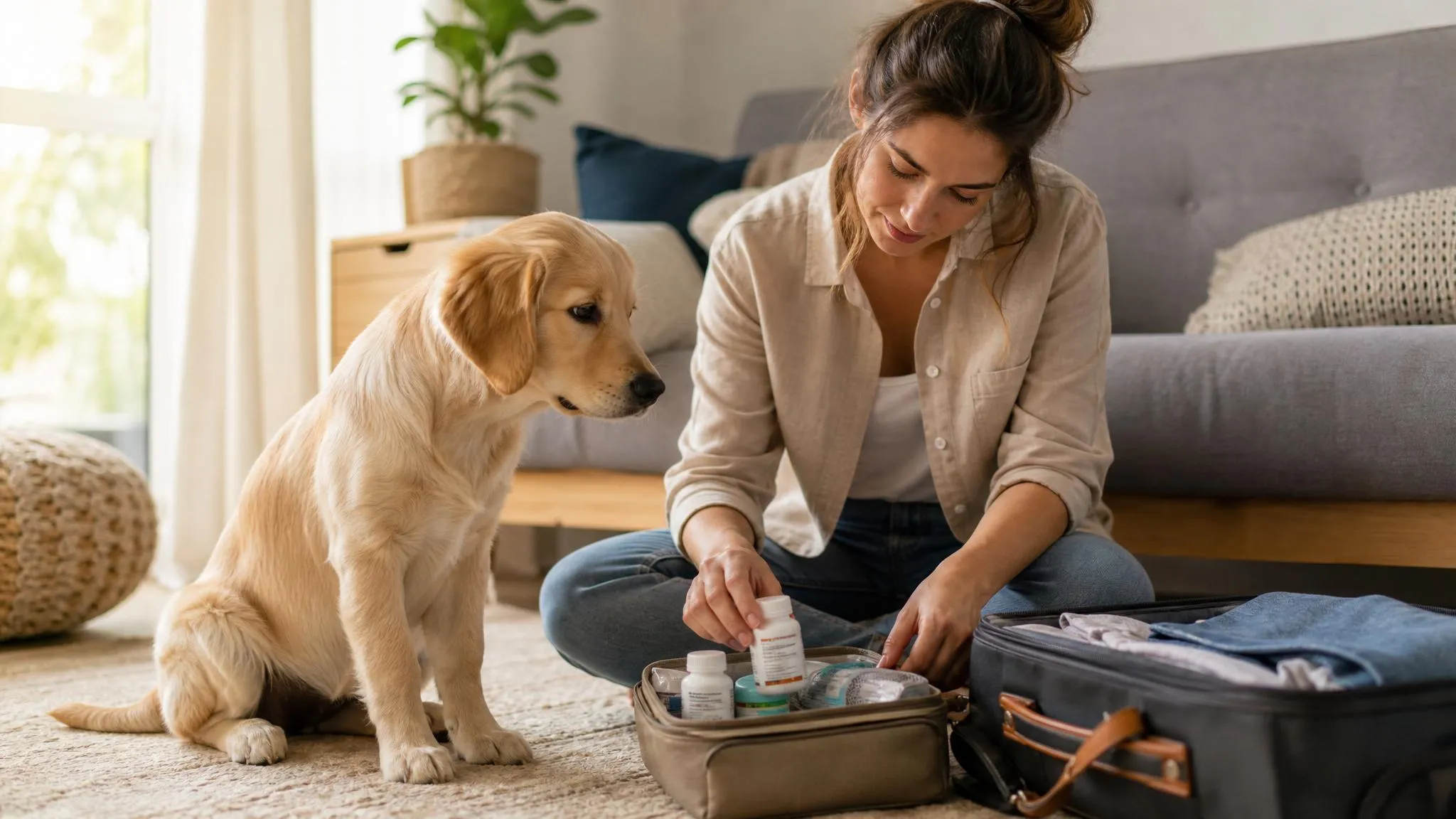
How to Travel With Dog Medication Without Missing a Dose
Traveling with dog medication takes more than tossing pills in a bag. Here's how to pack, plan, and keep every dose on schedule.
Traveling with dog medication sounds simple until you are actually doing it.
At home, the routine is kind of annoying, but at least the chaos is familiar. The bottle lives in the same drawer. The food is in the same place. Your dog has the same breakfast time, the same bedtime, the same little suspicious face when the pill appears.
Then you take a trip and suddenly the whole system breaks. Different schedule. Different food. Different timezone, maybe. Someone else is driving. The medication bottle is somewhere in the bag, unless it is in the other bag, unless you left it on the kitchen counter because future-you was apparently feeling brave.
That is why traveling with dog medication needs a plan. Not a dramatic one. Just enough structure so your dog’s care does not depend on memory while everyone is tired, distracted, and trying to enjoy the trip.
Start with the boring question: do you have enough?
Before packing anything, count the doses.
Not the bottles. Not the vibes. The actual doses.
If your dog takes medication twice a day and you will be gone for five days, you need at least ten doses. Then add extra. Travel delays happen. Cars break down. Flights get moved. Someone decides to stay one more night because the weather is good and the dog finally relaxed.
A good rule is to pack enough medication for the whole trip plus a few extra days. If the medication is important, and especially if it is hard to replace, do not cut it close.
This matters even more with prescriptions like antibiotics, seizure medication, heart medication, insulin, steroids, eye drops, or anything your vet told you not to skip. If you are unsure whether your dog’s medication is safe to interrupt, assume it is not and call your vet before the trip.
Keep the original container, even if it feels bulky
I get the temptation to move pills into a tiny travel case. It looks cleaner. It saves space. It feels organized.
But for traveling with dog medication, the original container is usually worth keeping. It has the medication name, dosage, instructions, expiration date, and prescribing clinic. If you need help from a vet while away from home, that label becomes very useful very fast.
If you do use a pill organizer for daily convenience, keep the original bottle with you too. Think of the organizer as the easy-access tool, not the source of truth.
This is also helpful if you are flying or crossing borders. Rules can vary, and having labeled prescriptions or vet documentation makes the conversation much easier than holding up a random plastic bag of pills and saying, “trust me, these are for the dog.” 😅
Protect meds from heat, cold, and the magical disaster zone called a car
Medication storage is one of those things pet parents often forget until the bag has been sitting in a hot car for three hours.
Some dog medications are fine at room temperature. Others need refrigeration. Some should be protected from light or moisture. The label should tell you what the medication needs, and if it is unclear, ask your vet or pharmacist before leaving.
As a general habit, keep medication in a cool, dry place and avoid leaving it in direct sun, a bathroom, a hot kitchen, or a parked car. Cars are especially risky because the temperature inside can change quickly. That cute little bottle in the glove compartment can go through a lot in one afternoon.
If your dog needs refrigerated medication, plan the cooler situation before travel day. Use an insulated bag, keep the medicine protected from direct contact with ice packs unless your vet says that is okay, and know where it will go once you arrive.
The goal is simple: the medication should arrive in the same condition it left.
Put the schedule somewhere your vacation brain can find it
The hardest part of traveling with dog medication is not always giving the medicine. It is remembering when to give it.
At home, routines do some of the work for you. On a trip, breakfast may happen late, dinner may be on the road, and bedtime may not mean anything because everyone is still unpacking. That is when doses get missed or doubled.
Write the schedule somewhere obvious before you leave. Include the medication name, dose, time, whether it goes with food, and any special instructions. If more than one person is helping, everyone should check the same schedule instead of relying on group chat chaos or “I thought you gave it.”
This is exactly the kind of situation Arya was built for. When Arya had complicated treatments, the scary part was not only the medicine itself. It was the constant second-guessing. Did I already give the drops? Was that antibiotic at 8 or 10? Did I write it down somewhere useful, or did I trust my brain again like a clown?
With Arya, you can set reminders, track doses, and keep the medication schedule in one place. That matters even more when you are away from home and the usual rhythm is gone.
Pack the vet info before you need it
If something goes wrong during a trip, you do not want to be searching your inbox for a phone number while your dog is acting weird.
Save your regular vet’s number. Bring a copy or photo of the prescription label. If your dog has a complicated medical history, keep a short note with current medications, diagnoses, allergies, and recent treatments. It does not need to be a novel. It just needs to help a new vet understand the basics quickly.
If you are traveling far, especially to another city or country, look up an emergency vet near where you are staying. You may never need it, which is ideal. But if you do, future-you will be very grateful that past-you was a tiny bit paranoid.
Do not improvise with missed doses while away from home
Trips are where mistakes happen. A dose gets skipped during a long drive. The pill was supposed to be given with food, but your dog refused breakfast. You realize at 11pm that the evening medication never happened.
The safest answer depends on the medication, how late you are, and your dog’s health. For many medications, doubling up is not the right move. For some medications, missing doses can be more serious. This is why the boring advice is also the correct advice: check the label and call your vet when you are not sure.
If your dog is on high-risk medication, ask your vet before the trip what to do if a dose is late or missed. That one question can save a lot of panic later.
Make the system easy enough to use when everyone is tired
A travel medication plan does not need to be fancy. In fact, fancy usually dies around day two.
Keep the meds together. Keep the schedule visible. Log each dose right after giving it. Bring extra. Protect the medication from bad storage conditions. Know who to call if something feels off.
That is the whole thing.
Traveling with dog medication is not about becoming the perfect pet parent. It is about removing the easy mistakes so you can focus on your dog and, hopefully, enjoy the trip a little too.
If you want one place to manage your dog’s medication reminders while you are away from home, you can download Arya for free on the App Store and Google Play. I built it because pet care is already stressful enough. Your reminder system should not be the thing making it worse. 🐾