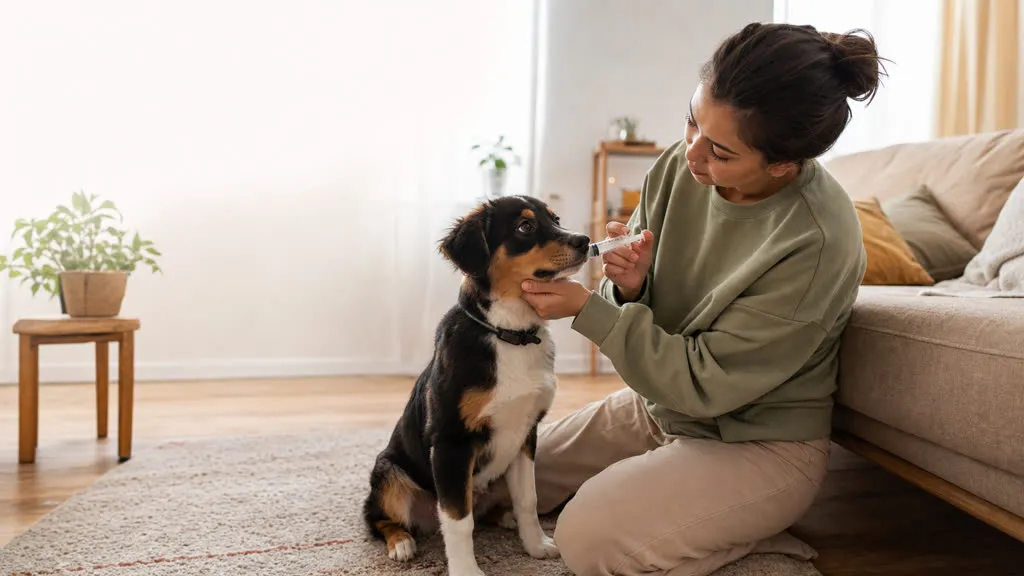
How to Give a Dog Liquid Medicine Without Turning It Into a Wrestling Match
How to give a dog liquid medicine with less stress, fewer spills, and a simple routine you can actually repeat every day.
Giving a dog liquid medicine sounds simple until you’re sitting on the floor with a tiny syringe, a suspicious dog, and the very real feeling that both of you are about to have a bad time.
I’ve been there with Arya. Not specifically because every treatment was liquid medicine, but because once your dog has a complicated health situation, the routine stops being cute very quickly. Pills, drops, antibiotics, vet instructions, refill dates, weird schedules. You start thinking, wait, did I already do the morning dose or was that yesterday? Super fun hobby, highly recommend. 🙃
So if you’re trying to figure out how to give a dog liquid medicine without wasting half the dose on their chin, the goal is not to become a professional vet tech overnight. The goal is to make the moment calm, repeatable, and safe enough that you can do it again tomorrow without dreading it.
Start before the syringe touches your dog
The biggest mistake is treating medication time like an ambush. Dogs are not dumb. If every time you walk toward them with a syringe you become tense, chase them around the house, and panic when they move, they will learn that the syringe means drama.
Before you start, read the label and the vet’s instructions slowly. Confirm the dose, whether it should be given with food, and how often it needs to happen. Shake the bottle only if the label says to. Draw up the medication carefully, then check the syringe at eye level so you know the dose is right.
That part sounds boring, but it matters. When Arya was going through treatment, the exhausting part was not one single pill or one single drop. It was the stack of tiny instructions that all felt important. Being organized before you call your dog over keeps you from improvising while your dog is already uncomfortable.
Pick the least chaotic spot in the house
For most dogs, the best place is somewhere familiar, quiet, and not too slippery. A rug, a couch corner, or the floor next to a wall can work better than a kitchen tile battlefield.
Try not to tower over your dog if that makes them nervous. Sit beside them or slightly behind them. If you have a small dog, you can use a towel or a soft blanket to help them feel secure, but don’t wrap them so tightly that it becomes a whole hostage situation. The vibe should be steady, not dramatic.
If your dog is very wiggly, ask another person to gently help. One person can keep the dog calm while the other gives the medicine. If your dog growls, snaps, or seems genuinely terrified, pause and call your vet. There is no prize for forcing it and making tomorrow worse.
Aim for the cheek, not straight down the throat
Most veterinary instructions for oral liquid medicine use the same basic idea: place the syringe into the side of the mouth, near the cheek pouch, then give the liquid slowly. You are not trying to fire the medication straight down their throat like a tiny water cannon.
Lift the lip gently and slide the syringe tip into the space between the cheek and the teeth. Keep your dog’s head in a natural position, not cranked upward. Then press the plunger slowly, giving them time to swallow.
Slow is the keyword here. If you push too fast, your dog may spit it out, cough, gag, or inhale some of it, which is obviously not what we want. A little pause between small amounts can make a huge difference, especially with dogs who hate the taste.
After the dose is in, keep the moment calm for a few seconds. Let them lick, swallow, and reset. Then give praise, a treat if the medication allows it, or just a quiet little celebration. Not everything needs to be a production, but your dog should learn that medicine time ends with something okay.
Don’t hide every dose in food without checking
I get the temptation. If your dog will take liquid medicine mixed into a spoonful of wet food, that feels like winning. And sometimes it is fine.
But check with your vet first. Some medications need an empty stomach. Some should not be mixed with certain foods. Some taste so bad that mixing them into your dog’s favorite meal can accidentally teach them to distrust that food too. Very rude of biology, honestly.
If your vet says food is okay, use a small amount first so you can be sure your dog eats the full dose. Mixing medicine into a whole bowl is risky because if they stop halfway through, you won’t know how much they actually got.
Track what happened, not just what was scheduled
This is the part people underestimate. Giving a dose is one thing. Remembering whether it was swallowed, spit out, delayed, vomited later, or skipped because your dog was at the vet is a different problem.
When you’re tired or worried, your brain becomes a terrible database. Ask me how I know.
Write down the time, the dose, and anything unusual. If your dog drooled a lot, refused food, vomited, seemed sleepy, or acted weird after the medicine, make a note. Not because every tiny thing is an emergency, but because patterns help your vet make better decisions.
This is exactly the kind of routine that made me build Arya: Pill Reminder in the first place. I needed a way to stop second-guessing myself while caring for Arya. If you prefer Android, it’s also on Google Play. Use whatever system works for you, but please use a system.
Know when to call the vet
If your dog spits out a little medicine, don’t automatically repeat the dose unless your vet has told you what to do. Double dosing can be more dangerous than missing a small amount, depending on the medication.
Call your vet if your dog vomits soon after the dose, coughs or struggles to breathe, has swelling or hives, becomes extremely lethargic, refuses repeated doses, or if you simply are not sure whether enough medicine went in. That is not being annoying. That is being responsible.
Make tomorrow easier
The best routine is the one you can repeat when you’re tired. Keep the medicine, syringe, treats, and notes in one place. Set reminders. Refill before the bottle is basically empty. Practice touching your dog’s mouth gently outside medication time so the syringe is not the only mouth-related experience they get.
Learning how to give a dog liquid medicine is partly technique, but mostly patience. You are helping a dog who doesn’t understand why this weird-tasting stuff matters. Keep it calm, keep it slow, and keep track of the details.
Future you, and your vet, will be very grateful.